
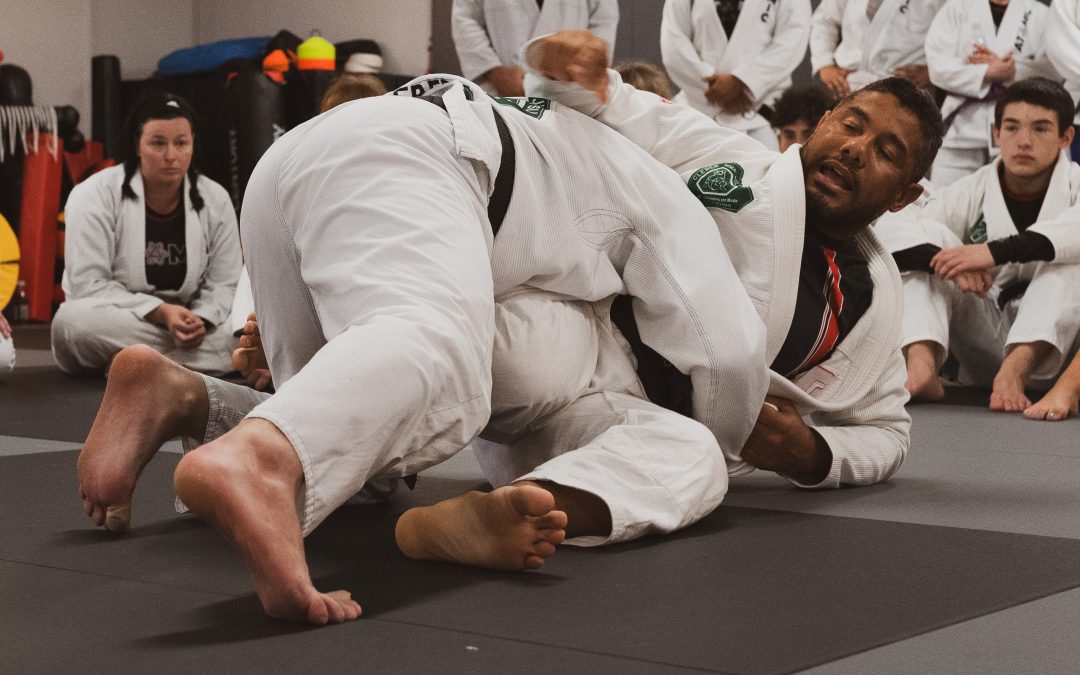
Which is Best for Self- Defense? Brazilian Jiu-Jitsu or Wrestling…Why not both!
Written by Adrian J Trevino – Brazilian Jiu-Jitsu Black Belt and USA Wrestling Certified Coach
When it comes to choosing a martial art for self-defense, the debate often revolves
around Brazilian Jiu-Jitsu (BJJ), wrestling, or a combination of both. Each discipline
brings unique strengths to the table, tailored to different aspects of self-defense
scenarios.
Brazilian Jiu-Jitsu (BJJ):
BJJ focuses on grappling and ground fighting, emphasizing techniques to control
opponents, submit them, or defend oneself when taken to the ground. This martial art is
particularly effective for smaller individuals facing larger opponents, as it leverages
technique and leverage over brute strength. BJJ practitionerslearn to neutralize threats
through joint locks, chokes, and positional control, making it highly practical in real-world
confrontations where physical altercation may escalate.

Wrestling:
Wrestling, on the other hand, emphasizes takedowns, body control, and positioning to
dominate opponents on their feet and keep them off-balance. Wrestlers are adept at
using their strength and agility to dictate where the fight takes place, which can be
crucial in self-defense situations to prevent being taken down or pinned. Wrestling also
instills mental toughness and the ability to quickly adapt to changing circumstances, traits invaluable in high-pressure encounters.
Combination Approach:
While both BJJ and wrestling offer formidable skills individually, combining them can
provide a more comprehensive toolkit for self-defense. Wrestlers who cross-train in BJJ
gain proficiency in ground techniques, enhancing their ability to transition seamlessly
from standing to ground-based scenarios. Conversely, BJJ practitioners benefit from
wrestling's emphasis on explosive movements and takedowns, broadening their
defensive capabilities in different engagement ranges.
Choosing the Right Martial Art:
The choice between BJJ, wrestling, or a combination thereof ultimately depends on
personal preferences, physical attributes, and specific self-defense goals. For someone
seeking to control and subdue opponents on the ground, BJJ might be ideal.
Conversely, individuals prioritizing stand-up defense and takedowns may find wrestling
more suitable. Many practitioners find that a hybrid approach, incorporating elements of
both disciplines, offers the most balanced skill set for diverse self-defense situations.
Summary:
In conclusion, while BJJ and wrestling each excel in distinct areas of self-defense, a
combination approach often provides the most versatile and effective solution. By
integrating techniques from both disciplines, practitioners can better prepare themselves
to handle a variety of physical confrontations, adapting their strategies based on the
circumstances they encounter. Ultimately, the best martial art for self-defense is the one
that aligns with an individual's strengths, preferences, and commitment to training.